- Info.
- Products
Digital Wireless System
Integrated Conference System
Wired Microphone
Audio Assistance - Kits
- XDC236 Series
- Products
- Products
- Components
Analog Wireless System
Wireless Conference System
Antenna
Acessories - Kits
- WDC210 Series
- Products
- Components
- Components
Digital Wired Conference System
- DC190 Series
- Others
DC power adapters are crucial to the performance of wireless equipment.
12V DC output power adapters are very common accessories.
While the price difference between various power adapters might be less than a dollar, their impact on wireless microphone performance is significant.
You might expect a power adapter to output a steady 12V DC signal, as shown in Diagram A. In reality, however, the voltage you get looks like Diagram B—uneven and riddled with spikes and noise.
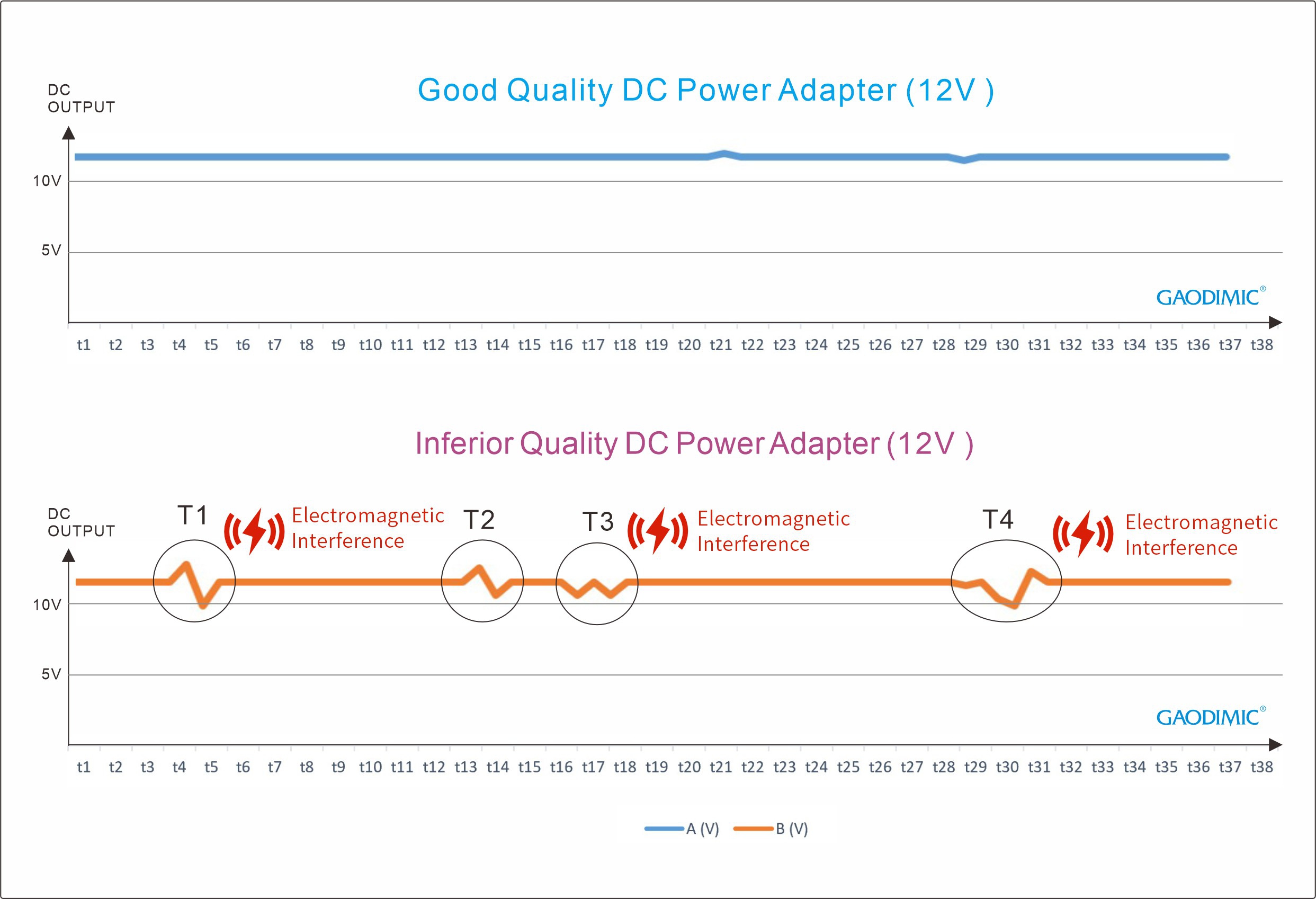
Achieving a smooth, stable 12V DC output places high demands on manufacturing quality, technical expertise, and component performance.
In theory, receiver PCBs include filtering circuits to eliminate unwanted noise. However, these filters cannot always remove everything completely, and the noise inevitably finds its way into the PCB's power section.
Any fluctuation in voltage or current generates electromagnetic waves; this is precisely how interference arises.
Consequently, low-quality power adapters can easily cause audible hum or popping noises in the audio circuitry and, in severe cases, interfere with the receiver's wireless performance.
============
Large LED screens are frequently used in performance settings, and they often present similar issues.
Large LED screens are composed of multiple display units, each powered by its own independent power module containing a voltage-boosting circuit.
In other words, these power modules act as sources of radio interference—interference that spans a wide frequency range and is unpredictable.
High-quality LED systems often employ centralized voltage-boosting circuits and robust radio shielding. However, to cut costs, manufacturers of budget-friendly LED screens frequently omit this shielding.
This is why wireless microphone receivers should not be placed near large LED screens—and certainly not directly behind them.
TEL : (+86)18665358040
Email : sales@infosvc.biz
Facebook : @GAODIMIC | Ins : @GAODIMIC



infoSVC Information Technology Service Co., Ltd
( infoSVC Co., Ltd )
Tradmark @2026